

Real Estate vs. Mutual Funds vs. FD: Where Does Your Money Actually Grow in India?


By Chandak Group
10 Mins
27th May 2026
0 like
Real Estate vs. Mutual Funds vs. FD: Where Does Your Money Actually Grow in India?
You have worked hard, saved carefully, and now you are wondering where that money should go.
Should you keep it safe in a fixed deposit? Should you invest through SIPs and let the market grow it over time? Or should you use it towards buying a home, especially in a city like Mumbai where property is both a financial asset and a family decision?
This blog compares fixed deposits, mutual funds, and real estate across returns, risk, liquidity, tax, and long-term value. More importantly, it helps you understand when each option makes sense, and when buying a home becomes a serious next step.
Quick Answer - Which Investment Is Better?
Fixed deposits are best when safety and short-term access matter most. Mutual funds are better suited for long-term market-linked growth, especially if you can stay invested for 5 to 10 years. Real estate makes sense when you have a larger corpus, stable income, and a long holding period, especially if you are buying a home in a high-demand city like Mumbai.
For many Indian families, the best answer is not FD vs mutual funds vs real estate. It is a balanced plan where FDs protect emergency money, mutual funds grow wealth, and real estate creates a liveable, long-term family asset.
Fixed Deposit vs. Mutual Funds vs. Real Estate: Which is the Smart Choice?
Are Fixed Deposits a Good Investment Option?
A fixed deposit is the simplest investment you can make. You give your money to a bank for a fixed period, and they give it back with interest.
What Works in Its Favour?
- Your capital is relatively safe when placed with a trusted scheduled bank.
- Returns are guaranteed upfront.
- During a financial emergency, you can break the FD with a small penalty.
- It is ideal for simply parking money while you decide what to do next.
What Works Against It?
- With current FD rates from major banks like SBI and HDFC at around 6.4% to 6.6% per annum, and India's CPI inflation at 4.6% in 2025, your real return after inflation is barely around 1.5%.
- The interest you earn is fully taxable as per your income slab. If you are in the 30% tax bracket, your post-tax return drops even further.
Best For: Risk-averse investors, senior citizens, people with short-term financial goals, or anyone who needs a safe place to park money for 1 to 3 years.
Are Mutual Funds a Good Investment Option?

A mutual fund pools money from many investors and is managed by a fund manager who invests it in assets like stocks, bonds, or gold.
What Works in Its Favour?
- Equity mutual funds in India have delivered 14% to 20% annualised returns over the past 5 years.
- You can start with as little as Rs. 500 per month through an SIP.
- Most open-ended funds allow you to withdraw your money within 1 to 3 working days.
- Your money is spread across multiple companies and sectors, which reduces the risk of depending on one business alone.
What Works Against It?
- It is not a short-term strategy. It requires patience and emotional discipline.
- There is no physical asset at the end of it. For many investors, especially in India, this feels uncomfortable.
- Returns are not guaranteed. A fund that gave 20% last year may not repeat that next year.
Best For: Long-term wealth creation over 5 to 10 years, salaried professionals, first-time investors, and anyone who wants to grow money without actively managing it.
Is Real Estate a Good Investment Option?

Real estate means buying a physical property, a flat, a house, or a plot. It is one of the oldest and most trusted forms of investment in India, and for good reason.
What Works in Its Favour?
- It is tangible. You can see it, live in it, and pass it on to your family.
- In high-demand cities, well-located properties can appreciate over time, especially when supported by connectivity, social infrastructure, employment hubs, and limited land supply.
- Real estate can be purchased using a home loan, which means you can own an asset worth much more than what you have in hand right now.
- For most Indian families, owning a home is a life goal, not just a financial decision.
What Works Against It?
- Real estate is better suited for long-term planning rather than quick gains.
- It is best suited for investors who are comfortable staying invested for 7 to 10 years.
Best For: Investors with a larger corpus and a long horizon, people buying a home to live in, and those who want a physical, tangible asset as part of their wealth plan.
Which Investment Is Right for You?
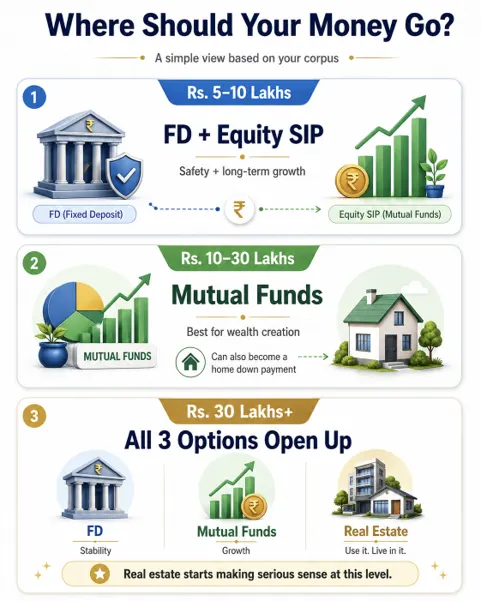
Click image to enlarge
The honest answer is that it depends on how much you want to invest and what stage of life you are in.
If you have Rs. 10 to 30 lakhs, mutual funds can still support wealth creation, but this corpus can also become the foundation for a future home down payment. At this stage, the decision depends on income stability, family needs, loan eligibility, and whether you plan to buy within the next few years.
If you have Rs. 30 lakhs or more, real estate starts entering the conversation seriously, especially in Mumbai. At this level, you may be able to combine a down payment with a home loan and convert savings into a physical asset that your family can live in and hold for the long term.
What Should You Check Before Buying a Property in Mumbai?
Before choosing real estate over FDs or mutual funds, check whether the purchase works for your life and not just your portfolio.
Look at:
- Your down payment readiness
- Monthly EMI comfort
- Emergency fund after booking
- Stamp duty, registration, GST, maintenance and interior costs
- RERA registration
- Developer track record
- Possession timeline
- Carpet area and usable layout
- Connectivity to work, schools, hospitals and public transport
- Resale and rental demand in the micro-market
- Reputation of the real estate developer in Mumbai and their track record of project delivery
A home is a long-term commitment. The right property should support your financial plan, your family's lifestyle, and your future flexibility.
Areas like Chembur, Borivali, Malad, Goregaon, Andheri, and Vile Parle are drawing buyers who want a real home in a well-connected part of Mumbai, not just a speculative asset.
To Sum It Up
FDs help protect money. Mutual funds can grow money over time. Real estate turns money into something tangible, lasting, and liveable, especially when the home is in the right city, the right location, and with the right developer.
For Mumbai buyers who believe real estate now makes sense for their goals, Chandak Group brings 40+ years of legacy, 12 million+ sq. ft. developed, 45+ completed projects, and 12,000+ happy families across the city.
| Project | Location |
|---|---|
| Chandak GreenAiry | Borivali |
| Chandak Highscape City | Chembur |
| Chandak Vansham | Vile Parle |
| Chandak Sarvam | Andheri |
| Chandak 34 Park Estate | Goregaon |
| Chandak Treesourus | Malad |
Planning to turn your savings into a Mumbai home? Explore Chandak Group's residential projects across Borivali, Chembur, Vile Parle, Andheri, Goregaon, and Malad, and speak to our team to find a home that fits your budget, lifestyle, and long-term goals.
Contact Us: +91-7620560000
Frequently Asked Questions
1. Is it better to invest monthly or put a lump sum into one asset?
For most investors, monthly investing through SIPs works well because it reduces the pressure of timing the market. A lump sum can work if you already have a large corpus and a clear goal.
2. How much emergency fund should I keep before investing in property?
Ideally, keep at least 6 to 12 months of household expenses aside before buying property. Real estate is not easy to sell quickly, so your emergency money should stay in liquid options like a savings account, liquid fund, or fixed deposit.
3. Can real estate and mutual funds be part of the same investment plan?
Yes. In fact, a balanced approach often works better. Real estate can give you a physical, long-term asset, while mutual funds can offer liquidity and market-linked growth.
4. What hidden costs should I check before buying a property?
Apart from the listed property price, check stamp duty, registration charges, GST (if applicable), maintenance deposits, brokerage, parking charges, legal fees, loan processing fees, and interior costs. These can significantly increase the total cost of ownership.