
What Should First-Time Homebuyers in Mumbai Know Before Booking a Flat?


By Chandak Group
10 Mins
5th June 2026
0 like
What Should First-Time Homebuyers in Mumbai Know Before Booking a Flat?

TL;DR
Booking a flat in Mumbai involves more than choosing a location or calculating an EMI. Before paying the booking amount, check the project's RERA status, total cost, carpet area, approvals, developer track record and possession timeline. This guide explains the key checks to make before paying the booking amount, so buyers can make a confident and informed decision.
Buying your first home in Mumbai feels exciting, emotional, and slightly overwhelming. With options ranging from compact apartments near business hubs to larger family homes in micro-markets, there’s no shortage of choice.
But for first-time buyers, the challenge isn’t finding a flat. It’s knowing what to check before booking one.
Most first-time home buyers start with questions like, “Can I afford this EMI?”, “Is this location good?”, or “Should I book now before prices rise?” While these matter, they’re only part of the picture.
Before paying the booking amount, you need to look at the total cost, RERA status, approvals, carpet area, possession timeline, developer track record and future resale potential.
Here’s a first-time home buyer guide for Mumbai that breaks down the practical checks every buyer should make before booking a flat.
Key Takeaways
- Always check RERA registration on MahaRERA before paying even a token amount.
- Carpet area is the only legally recognised area under RERA — always compare on that basis.
- Request the full cost sheet, not just the base price.
- Evaluate the developer’s past delivery record before anything else.
- Understand parking, maintenance deposits, and amenity charges upfront.
- Under-construction projects offer lower entry prices; ready-to-move saves on GST.
- Read the booking form carefully, especially cancellation and refund clauses.
10 Things to Know Before Booking a Flat in Mumbai
1. Budget: Look Beyond the EMI
Many first-time buyers start with the EMI, but your budget should include much more than the monthly loan amount.
You need to plan for the down payment, stamp duty, registration charges, GST if applicable, parking, maintenance deposits, interiors, loan processing fees and moving expenses. If you are currently living on rent, also consider the overlap between rent and EMI.
Your total monthly outgo (EMI + maintenance) should ideally not exceed 35–40% of your take-home income. Use Chandak Group’s free EMI Calculator to map out your monthly outgo before visiting any project.
2. Verify the Project on MahaRERA First
Every legitimate real estate project in Maharashtra must be registered with MahaRERA. Check the RERA number at maharera.maharashtra.gov.in to confirm possession date, approved layout and registered promoter details before paying a rupee.
RERA checks are especially important because they reduce dependency on verbal claims. If the project details are different from what you were told, you can spot the mismatch early.
Also Read: RERA: An Empowering Tool
3. Carpet Area vs Built Up Area: Know the Actual Usable Space
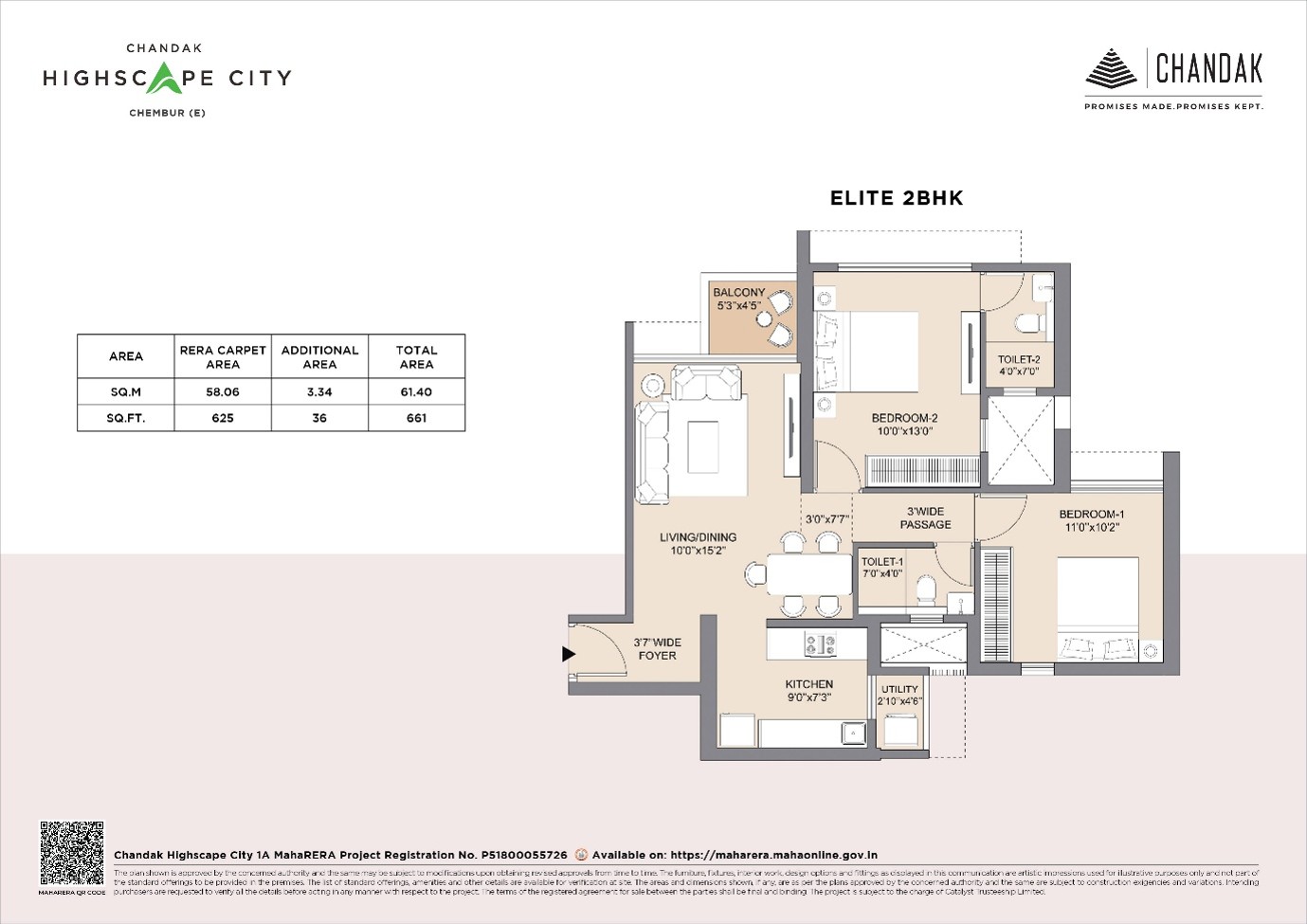
Do not compare flats only by BHK type or brochure size. A 2 BHK in Goregaon West in one project may feel very different from a 2 BHK in another project because of carpet area and layout efficiency.
Carpet area is the actual usable area inside the home. Built-up area may include walls and other components. Focus on how much space you'll actually use every day.
Check the room sizes, passage space, kitchen layout, bathroom placement, storage possibilities, balcony usability and natural light.
4. Location: Look Beyond Connectivity
Evaluate the location across four lenses: daily commute and conveniences, proximity to schools and hospitals, upcoming infrastructure (metro, roads), and rental yield/resale demand.
Visit the location during peak hours if possible because the distance on a map can feel very different in real traffic.
Also think long term. Will the location remain useful if your family grows? Is there rental demand? Is resale likely to be easier because of connectivity and infrastructure?
5. Ready-to-Move or Under-Construction Homes: Which to Choose?
Under-construction projects typically offer lower entry prices and flexible payment plans, but carry delivery risk. Ready-to-move homes have no GST (for OC-received projects), zero possession risk, and immediate occupancy, usually at a premium.
| Factor | Under Construction | Ready to Move |
|---|---|---|
| Price | Lower | Higher |
| GST | 5% | Nil (if OC received) |
| Wait Time | Typically 2–4 Years | Immediate |
| Customisation | Possible | Limited |
| Risk | Delivery Delay Risk | None |
The right choice depends on your budget, timeline, risk comfort and whether you are buying for self-use or investment.
6. Property Documents to Review Before You Sign
Before booking, ask for the important project and transaction-related documents.
- MahaRERA Registration Certificate (verify independently online)
- Commencement Certificate (CC): confirms government approval to build
- Approved Floor Plan: compare with the layout shown to you
- Draft Sale Agreement: review with a lawyer before signing
- Title Search Report: confirms clear land ownership
Also Read: Buying a House? Here’s a Documents Checklist
7. Booking Form and Cancellation Terms
Never treat the booking form as a formality.
Check:
- What’s the cancellation fee?
- How long does the refund take?
- What are the payment milestones?
- What are the default interest rates?
Never sign under time pressure. Always keep a copy of the signed booking form and payment receipt.
8. Check the Developer’s Track Record
Buyers in 2026 value location, facilities and the builder’s credentials over price alone.
Check the developer’s completed project portfolio, look up RERA complaints, and speak to existing residents if possible.
Chandak Group, with a 40+ year legacy and homes created for over 12,000 families, operates with the ethos of “Promises Made. Promises Kept.” - with almost all projects delivered on schedule.
9. Parking, Maintenance and Other Practical Costs
Parking and maintenance can affect your daily convenience and monthly expenses. Ask whether parking is included or charged separately.
Ask specifically:
- Is parking included or extra?
- What is the monthly maintenance per sq. ft.?
- What is the corpus/sinking fund deposit?
- What amenities are offered and what is their maintenance cost?
10. Ask for the Total Cost Sheet
Ask for a complete cost sheet that shows stamp duty, registration, GST, parking, infrastructure charges, maintenance deposit, legal/documentation charges and any other line items.
If any charge is unclear, ask the sales team to explain it in writing.
Common Mistakes First-Time Buyers Make Before Booking a Flat
- Deciding based on the show flat: show flats are often larger and more finished than what you’ll receive.
- Skipping RERA verification: while assuming a reputed brand name is enough.
- Comparing super built-up areas instead of carpet area across projects
- Not reading the cancellation clause in the booking form.
- Ignoring total cost and only looking at the base price and EMI.
- Skipping a lawyer review of the draft agreement.
- Letting urgency override due diligence: “last few units” is a sales tactic, not a fact.
Final Thoughts
Mumbai’s real estate market is active, competitive and full of genuine opportunity, but the buyers who get the best outcomes are the ones who slow down and do the work before they sign.
Use this first-time home buyer guide for Mumbai as your checklist, verify everything independently and never let time pressure shortcut your due diligence.
If you are planning to buy your first home in Mumbai, explore Chandak Group’s residential projects across Vile Parle, Andheri, Chembur, Malad, Goregaon and Borivali.
Frequently Asked Questions
1. What should a first-time homebuyer check before booking a flat in Mumbai?
A first-time homebuyer in Mumbai should check the project’s RERA registration, total cost sheet, carpet area, possession timeline, payment schedule, location connectivity, legal documents, parking details, maintenance charges and developer track record before booking a flat.
2. What documents should I check before booking a flat?
Before booking a flat, check the RERA registration details, approved plans, draft agreement for sale, cost sheet, payment schedule, possession date, parking terms, maintenance details, booking form and cancellation policy.
3. Is it better to buy a ready-to-move or under-construction flat in Mumbai?
Ready-to-move flats offer more certainty and faster possession, while under-construction homes may offer flexible payment plans and potential appreciation. The better choice depends on your budget, possession timeline and comfort with construction-stage risk.