

What Is Carpet Area, Built-up Area And Super Built-up Area?


By Chandak Group
10 Minutes
17th July 2026
0 like
What Is Carpet Area, Built-Up Area and Super Built-Up Area?
If you have ever compared two apartments of the "same size" and found one felt noticeably smaller, you are not imagining things.
The difference often comes down to how that size was measured. Builders use three common terms, carpet area, built-up area and super built-up area, and each one means something different.
Understanding these terms helps you know exactly what you are paying for. Before finalising a purchase, it's also worth understanding the complete home buying process in Mumbai. Let's break them down one by one.
What Is Carpet Area?
Click to expand
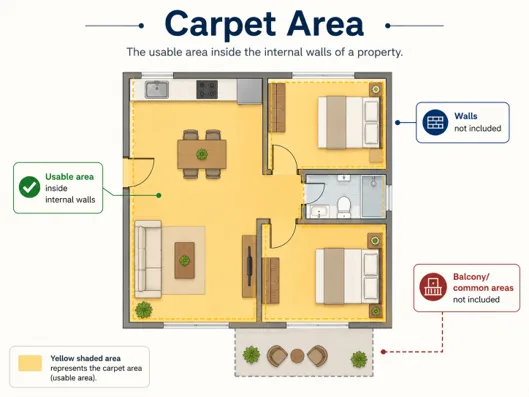
Carpet area is the simplest and most used of the three. It is the actual usable floor space inside your home, the space you could cover with a carpet if you wanted to. It includes rooms like your bedroom, living room, kitchen and bathrooms, and it also includes the thickness of internal partition walls.
It does not include:
- External walls
- Areas under service shafts
- Exclusive balcony or verandah area
- Exclusive open terrace area
This is not just a builder's estimate. Under Section 2(k) of the Real Estate (Regulation and Development) Act, 2016 (RERA), carpet area has an official, legal definition. RERA introduced this so every builder in the country measures and discloses area the same way, instead of using their own formulas. This is one of the reasons, it is always adviced to buy RERA approved projects in Mumbai and India.
Since RERA came into effect, carpet area is also the basis on which the sale price of a home must be calculated. This was a big shift, because before RERA, many builders priced homes based on a much larger number, the super built-up area, which we will get to shortly.
What Is Built-Up Area?
Click to expand
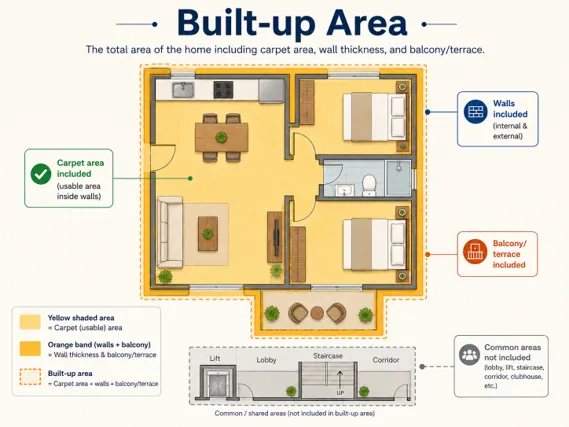
Built-up area is a bigger number than carpet area. It includes:
- The full carpet area
- The thickness of external and internal walls
- Balconies attached to the unit
- Any exclusive corridor area, if applicable
In simple terms, built-up area answers the question, "how much space does this home physically take up, including its walls?" It usually works out to about 10 to 20 percent more than the carpet area, though this can vary from project to project.
Built-up area is not used to decide the legal sale price under RERA, but you will still come across it in brochures and floor plans, so it is worth understanding.
What Is Super Built-Up Area?
Click to expand
Super built-up area is the largest of the three numbers, and it is the one that used to cause the most confusion before RERA.
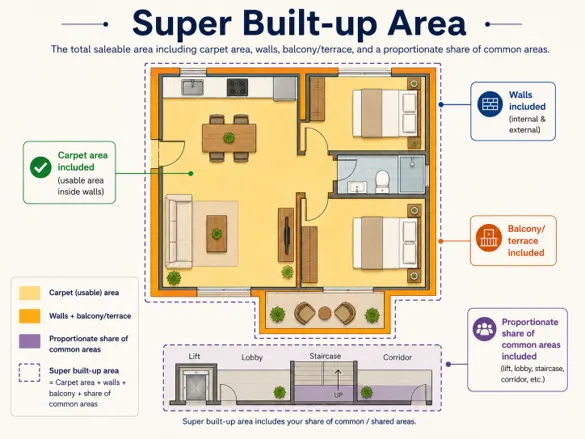
It includes the built-up area plus a proportionate share of the common areas in the building, such as:
- Lobbies and staircases
- Lift shafts
- Clubhouse and other shared amenities
The extra area added on top of the built-up area is often called the "loading factor." So if a building has a lot of shared amenities, the loading factor, and therefore the super built-up area, will be higher.
Before RERA, developers commonly quoted prices based on super built-up area, which meant buyers were often unclear about how much of that area they could actually use. RERA changed this by requiring that pricing be based on carpet area instead, so buyers know exactly what they are paying for.
Quick Comparison
Here's a simple side by side view of all three terms.
| Term | What It Includes | Typically Compared to Carpet Area |
|---|---|---|
| Carpet Area | Usable indoor space, internal wall thickness | Baseline (100%) |
| Built-Up Area | Carpet area, external and internal walls, balconies | Around 10 to 20% more |
| Super Built-Up Area | Built-up area, plus share of lobbies, lifts, staircases, amenities | Around 25 to 35% more |
A simple example.
Imagine an apartment with a carpet area of 800 sq ft.
Its built-up area might work out to around 920 to 960 sq ft once you add wall thickness and balconies.
The super built-up area, once you add a share of the building's common areas, could come to around 1,050 to 1,100 sq ft.
These figures are illustrative and will vary by project design and layout.
Why This Matters When You're Buying a Home
Knowing these terms protects you as a buyer. A few practical points to keep in mind.
- Always ask the developer for the RERA carpet area of the unit, since this is what your price is legally based on.
- Check the project's RERA registration on your state's RERA website. It should clearly list the carpet area for each unit.
- If the carpet area delivered is smaller than what was promised in the agreement, the builder is required to refund the difference with interest.
- Don't compare two projects only on their super built-up area, since a higher loading factor does not always mean better amenities.
How Chandak Group Brings Clarity to This
At Chandak Group, area disclosure is kept simple and transparent, in line with RERA requirements. Every project is registered with MahaRERA, and the carpet area for each unit is clearly stated in the agreement and marketing material, so buyers know exactly what they are paying for from day one.
This approach is reflected across Chandak Group's ongoing projects. For instance:
- Chandak Vansham, located in Vile Parle West, is designed with clearly defined carpet areas across its unit configurations.
- Chandak Treesourus, in Malad West, follows the same principle of transparent, RERA compliant area disclosure.
- Chandak HighScape, in Chembur East, and Chandak GreenAiry, in Borivali East, both carry forward this practice of clear, upfront documentation so buyers can make informed decisions.
This kind of transparency matters because buying a home is one of the biggest financial decisions most people make. When a builder is upfront about carpet area, RERA compliance and pricing, it builds the kind of trust that a one-time transaction alone cannot.
Conclusion
To sum it up in one line each. Carpet area is the usable space inside your home. Built-up area adds the walls and balconies. Super built-up area adds a share of the building's common spaces on top of that.
Understanding the difference means you always know exactly what you are paying for. And when you choose a builder who discloses this clearly, like Chandak Group does across projects, that clarity becomes one less thing to worry about. Contact us to know more about our projects across Mumbai.